
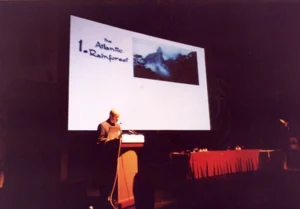
For a decade, I worked with biologist Andrée Vieira. For years, we ignored the fact that our ideas, presented to the IUAPPA organization in different parts of the world, were competing for a prize. The story is quite funny, but I won’t tell it now.
This post serves only to briefly explain what the Hopes for the Future of a Sustainable World award (or, for short, The Hopes) was. And what, in essence, are the Three Principles I advocate.
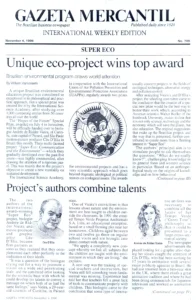
THE HOPES (Gazeta Mercantil newspaper, special report, Nov-4th-1996)
Unique eco-project wins top award
” The IUAPPA (International Union of Air Pollution Prevention and Environmental Protection Association), with the cooperation of the Ecology chairman members of the IAS (International Science Academy), regularly awards prizes for environmental projects and has a very scientific approach which goes beyond dogmatic, ideological or political stances on ecological issues. The awards usually concern projects in the fields of ecological techniques, alternative energy and pollution control.
After studying over 1.000 competing entries from 50 countries all over the world, and analyzing Vieira´s and D´Ellia´s project, the selecting committee came to the conclusion that the creation of a special new prize would be the best way to honor their work which, according to Austrian scientist Walter Kofler of the Innsbruck University, make it clear that it is not only science, technology and the economy which will save the planet, but also education.”
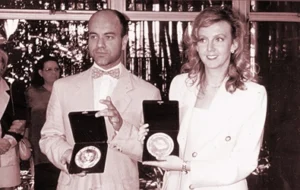
Well, above is an excerpt from a bilingual Brazilian newspaper, published in 1996, telling a little about the award we received. At the time, Andrée and I were combining our skills, and the project, then called Super Eco, combined Education and Mass Communication. In 1999, we decided to part ways. My partner wanted to focus on Education, and I, on the other hand, on Culture and Mass Communication.
JUSTIFICATION: Environmental Crisis x Knowledge Crisis
My main justification for my proposition is that there is no Environmental Crisis because the environment is self-regulating. No matter what happens, it constantly adapts. The problem for human beings is how they deal with it, and that depends on their knowledge. To what extent what humanity calls knowledge is capable of confronting environmental changes. Therefore, what we are actually experiencing is a Knowledge Crisis, not an Environmental Crisis.
It’s very important to understand what the word “Knowledge” means, or what I mean by that word. Human knowledge is everything that human beings believe and think to be true. This includes not only science, but also culture. Culture means values and belief systems. And something can be credible, but not necessarily true.
This concept is in line with Thomas Kuhn’s notion of Paradigm Shift.
PROPOSITION: Three Ethical Principles
Considering the current situation in our world, and to better harmonize with its adjustments, I propose three ideas:
- ECO-EFFICIENCY: This is the only principle that can lead to regulation. It means that products, especially those intended for children, must be manufactured with eco-efficient materials – those that do not pollute or impact the environment, as far as possible. These are called Green Products.
- BIOPHILIA: It’s loving life. Initially, I identified the concept through my own observations. But later, I discovered that others had already described it. For example, sociobiologist E.O. Wilson defines it as “the impulse to affiliate with other forms of life.” I say that Life is a gift that contains within itself a Love that sustains it. Awakening children of any age to this is something I believe in and that moves me. Any type of art or cultural product can be made with this content value in mind and become a contribution to a Culture of Life.
- The Key-Question – WHAT DO WE REALLY KNOW?-: It’s a question that, when asked, makes us more careful and aware of our limitations. Most of the harm we cause, including to ourselves, others, and the world we live in, results from our over-certainty.
Principles 2 and 3 above are philosophical concepts.
I’m not saying, in any way, that any artistic or cultural production must obey a content canon. What comes first is FREEDOM OF EXPRESSION, because this freedom is the path that intuition leads to a healthy spirit. We can consider these principles 2 and 3 more as propositions, as something to meditate on when we produce thoughts, art, entertainment, communication, technology, science, etc.
After all, what do we really know?
In a future post, I plan to better explain everything I’ve published here, especially the Three Principles. It would be very helpful if you commented, criticized, or asked questions using the comments section below. Please do so. Everyone is welcome.
Céu D´Ellia